8 Problem Solving Challenges for Team Building
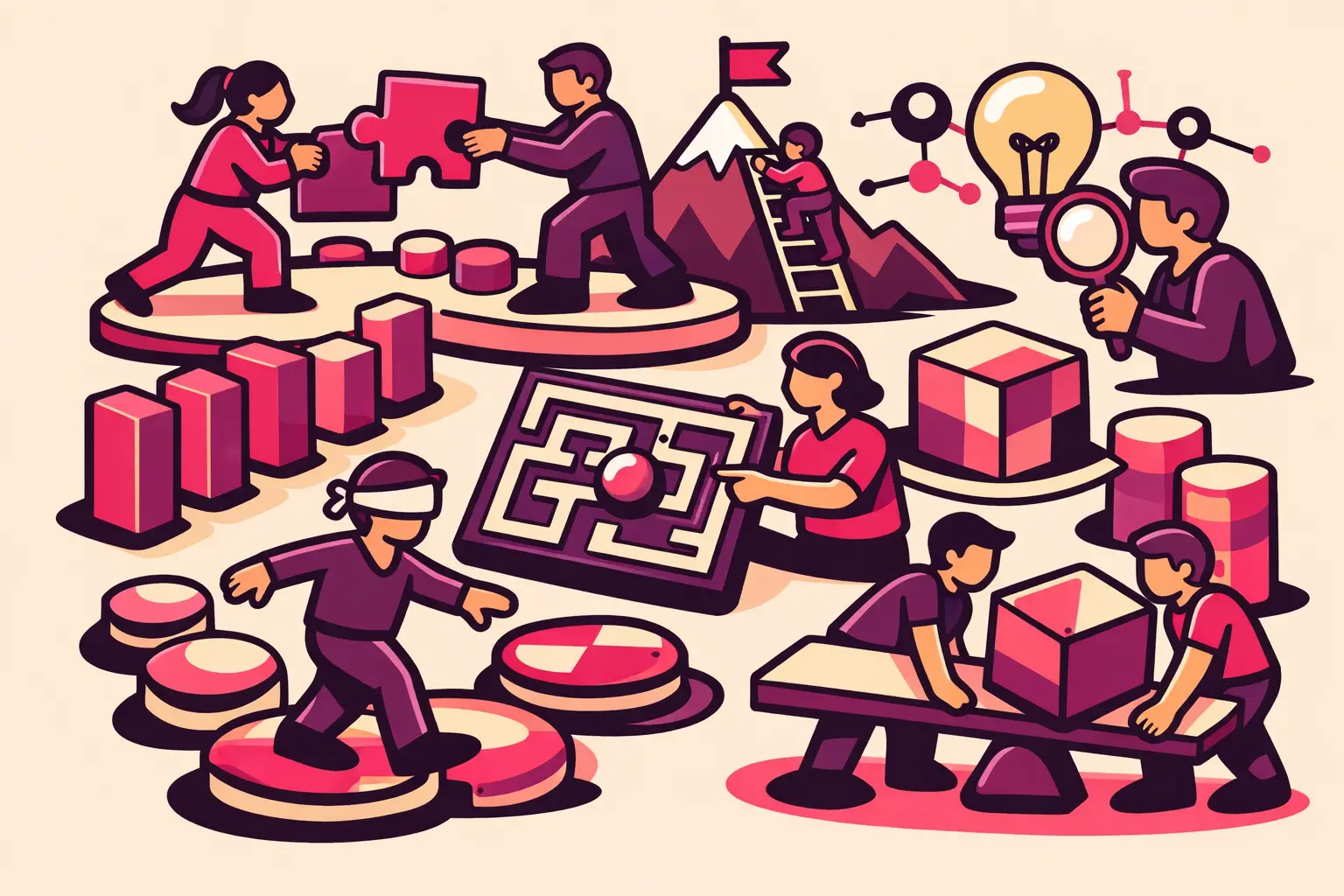
A team can sit through a meeting, share a pizza, and still not learn how to work together under pressure. That is why problem solving challenges for team building tend to stick. They put people in motion, force real decisions, and reveal how a group communicates when the clock is running and the answer is not obvious.
For work teams, friend groups, families, and student groups, the best challenge is not just hard. It is structured in a way that gets everyone involved. A great team-building activity creates enough friction to make people think, but not so much that one loud voice takes over or half the group checks out. That balance matters more than people expect.
Why problem solving challenges for team building work
Most groups do not struggle because people lack ideas. They struggle because ideas stay trapped in individual heads. Problem solving challenges create a shared objective with immediate stakes. Suddenly, communication is not abstract. People have to explain what they see, listen to what others notice, and decide what to do next.
That is what makes these activities useful. You get to watch leadership emerge, see who organizes information well, and notice where teams stall. Some groups move fast but miss details. Others analyze everything and run out of time. Neither style is wrong, but both reveal habits that show up in real life.
The strongest activities also reward different strengths. One person might spot patterns, another might stay calm, and someone else might keep the group focused. Team building works better when success does not depend on one specific personality type.
What makes a good challenge
A good challenge has a clear goal, a real constraint, and enough complexity to require cooperation. If the task is too easy, it feels childish. If it is too confusing, people get frustrated and disengage. The sweet spot is a challenge that looks manageable at first, then pushes the group to adapt.
Time limits help. So do incomplete information and physical movement. When teams have to search, sort, test, and decide, they stop acting like an audience and start acting like a unit. That is especially true for groups that do not normally spend time together outside work or school.
It also helps when the activity feels like an experience, not an exercise. People show up with more energy when they are solving a mission, cracking codes, or beating a countdown instead of filling out a worksheet with a team-building label on it.
8 problem solving challenges for team building
1. Escape room missions
Escape rooms are one of the most effective team-building formats because they combine communication, logic, time pressure, and shared focus in one experience. Teams have to search for clues, connect details, solve puzzles, and keep momentum without losing track of the bigger objective.
This format works because everybody can contribute in a different way. Some people notice hidden details. Others organize information or solve logic steps quickly. Strong groups learn how to split tasks without becoming scattered. If your team wants something active and memorable in Philadelphia, an in-person escape room is a strong choice because it feels like a real event instead of a forced workshop.
2. The blind build challenge
In this activity, one or two teammates can see the materials and the design goal, while the rest have to build without direct visual access. The team succeeds only if instructions are clear and feedback stays calm.
This challenge is great for exposing communication gaps. Vague language falls apart fast. So does impatience. It is simple to run, but it works best with a short time limit and a build target that is not too easy. Think structure, shape, or pattern rather than pure decoration.
3. Clue relay puzzles
A clue relay divides information across stations or rounds. Teams must solve one clue to reach the next, with each step requiring them to carry forward something they learned earlier. This creates pressure without making the activity overly technical.
The main benefit is pacing. Teams get quick wins, but they still need strategy. It also limits the common problem of everybody crowding around the same puzzle. People stay engaged because progress happens in stages.
4. Resource trade challenges
Give small groups limited supplies and a final objective that cannot be completed without negotiation. Maybe one team has too many connectors and no base pieces, while another has the opposite. The twist is that they need each other to finish.
This works well for larger groups because it adds decision-making and diplomacy. Teams have to figure out what to keep, what to trade, and how to communicate value. It is especially useful when you want to highlight collaboration across departments or friend groups that do not already mix naturally.
5. The locked briefcase game
This challenge centers on one secured object, box, or case with multiple layers of clues leading to the final opening. It creates a strong focal point and keeps the group aligned around one visible target.
The format is effective because it gives teams a simple mission while still allowing for varied puzzle types. You can combine ciphers, hidden objects, sequencing, or pattern recognition. It feels exciting because every solved piece clearly moves the group closer to the payoff.
6. Logic grid races
Logic puzzles can be great for team building when they are done in teams instead of individually. A grid-based deduction race forces people to test assumptions, share evidence, and challenge each other without getting personal.
The trade-off is that this style appeals more to analytical groups than highly physical ones. If your team likes structured thinking, it works well. If they need movement and energy, pair it with a more active task.
7. Story-based mystery solving
A mystery challenge asks teams to piece together what happened using statements, evidence, timelines, and hidden contradictions. This format is strong because it brings personality into the problem-solving process. People tend to engage more when there is a story to follow.
It also creates room for debate, which can be useful. Teams have to weigh evidence, not just rush to an answer. The key is making sure the clues are fair. If the mystery depends on random guessing, the activity loses momentum fast.
8. Timed multi-room scavenger challenges
A scavenger-style challenge works best when it includes layered tasks rather than simple item hunting. Teams should have to interpret clues, solve mini-puzzles, and decide where to go next. The movement keeps energy high, while the puzzle element keeps the activity from feeling shallow.
This format is good for big groups and event settings. The downside is that it can become chaotic if the instructions are weak. Clear rules and good pacing matter a lot here.
How to choose the right team-building challenge
The right activity depends on your group size, energy level, and why you are getting together in the first place. A corporate team may want something that rewards communication and role flexibility. A birthday group may care more about fun, pace, and a strong shared win. Families often need a challenge with mixed difficulty so younger and older players can both contribute.
Experience level matters too. First-time participants usually do better with an activity that gives frequent feedback and visible progress. More experienced groups may want layered puzzles, red herrings, and tighter time pressure. The goal is not to overwhelm people. The goal is to create a challenge that feels exciting and fair.
If you are planning for coworkers, avoid activities that are so open-ended that one person dominates the whole thing. If you are planning for friends, pick something with enough movement and surprise to keep the energy up. If you are hosting out-of-town guests in Philadelphia, choose an experience that feels like a real destination, not something you could do half-asleep in a conference room.
Common mistakes that weaken team building
One mistake is picking an activity that sounds fun but does not actually require teamwork. If one person can solve everything while everyone else watches, it is entertainment, not team building.
Another problem is making the challenge too complicated too early. Teams need a way in. Early traction builds confidence and gets quieter people involved. Without that, groups can stall before they really begin.
There is also a tendency to over-explain. The best challenges give people enough direction to start, then let them figure things out. Too much setup drains energy. Too little creates confusion. Good design sits in the middle.
Why immersive challenges leave a stronger impression
People remember what they felt, not just what they did. That is why immersive formats tend to outperform generic games. When a team enters a themed space, takes on a mission, and races a countdown, the challenge feels immediate. People react more honestly, communicate more actively, and celebrate wins more naturally.
That is also why escape rooms keep showing up in team-building conversations. They blend entertainment with real cooperation in a way that feels earned. At MindEscape, that mix is exactly the point. The group is not pretending to work together. They are working together, and everyone can feel the difference.
If you want a team-building activity people will still talk about next week, pick a challenge that gives them a problem worth solving together.
Connect Each Challenge to a Team-Event Decision
A list of problem-solving challenges is most useful when it explains the behavior each format invites. Logic exercises favor discussion, build tasks expose planning and handoffs, and an escape room combines searching, pattern recognition, information sharing, and a fixed deadline.
Thai Prison is MindEscape's concrete 2–12-player example, with Medium difficulty and all puzzles playable seated. Use it as an example of format and capacity, not as proof that every team will produce the same result.
Use these MindEscape planning paths
- Thai Prison Escape — see the concrete higher-capacity example
- corporate inquiry — turn the exercise into an actual event plan
- activity scorecard — evaluate the option transparently
- results and debrief guide — avoid unsupported outcome claims