Escape Room Versus Scavenger Hunt for Groups
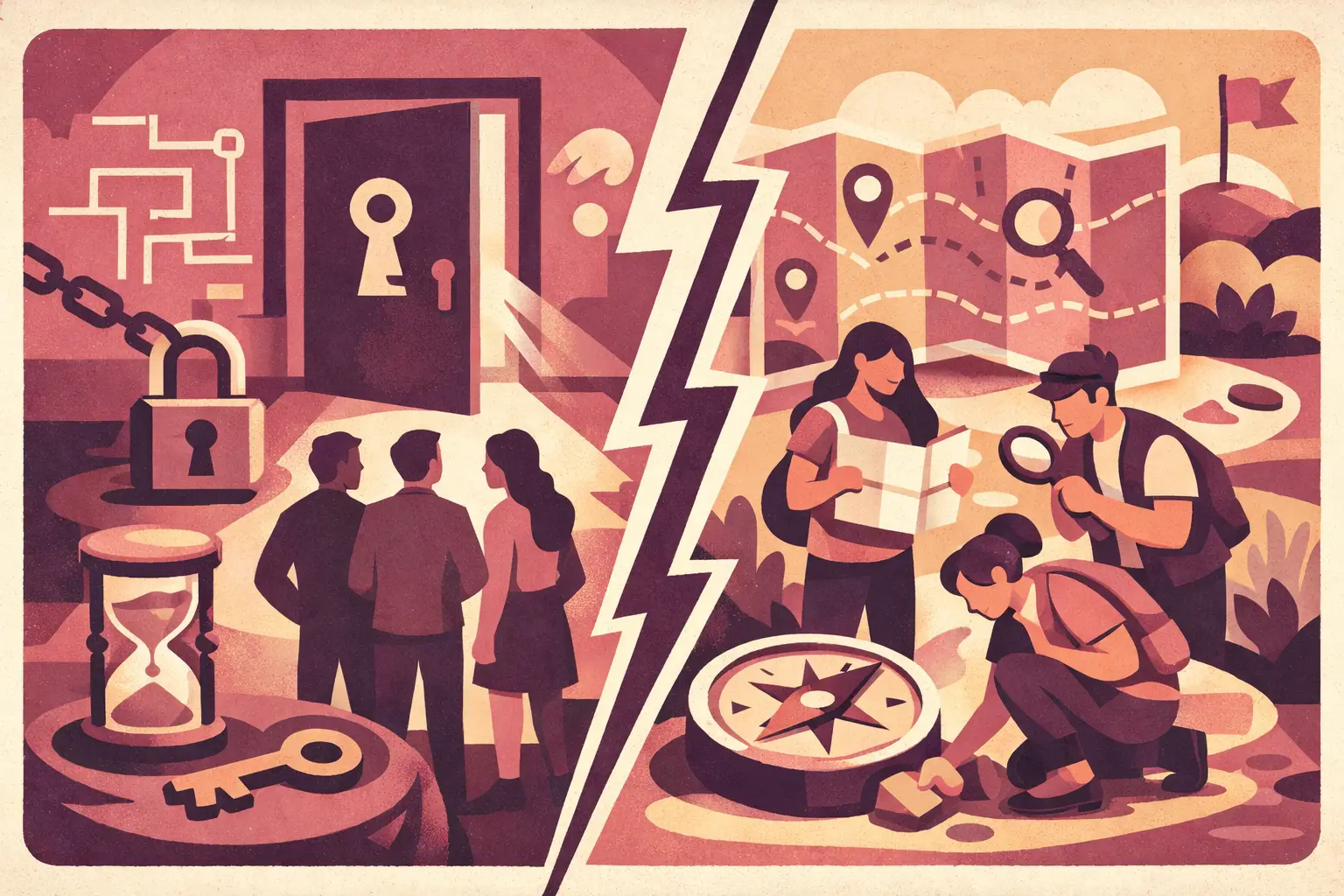
A group has gathered, someone is checking the time, and the organizer needs a plan that will hold everyone’s attention. That is where the escape room versus scavenger hunt question gets real. Both can get people talking, moving, and solving clues together. But they create very different kinds of memories.
A scavenger hunt sends your group outward to find things, follow prompts, and navigate a neighborhood, venue, or event space. An escape room brings the mission into one immersive setting, where the clock is running and every discovery may change what your team tries next. Neither is automatically the right choice. The better fit depends on your group, the occasion, and how much structure you want.
Escape room versus scavenger hunt: the core difference
The biggest difference is not simply indoors versus outdoors. It is the shape of the experience.
In a scavenger hunt, the destination is spread out. Your group may travel between checkpoints, take photos, answer location-based questions, or collect items. The activity often depends on the surroundings, so weather, walking distance, crowds, and phone batteries can affect the day. That can be exactly the appeal for a group that wants to explore Philadelphia or turn a larger event into a moving challenge.
In an escape room, the environment is part of the story. Your team enters a themed space with a defined objective and a set time to work together. Instead of looking across a city block or a festival venue, you are looking closely at the room, the clues in front of you, and the connections your teammates notice. The pace tends to build as the group sorts information, tests ideas, and makes progress together.
For people who want a contained, story-driven activity with a clear beginning and finish, an escape room is usually the stronger match. For people who want a flexible outing built around exploration and movement, a scavenger hunt may make more sense.
Choose an escape room when you want everyone in the same moment
A well-run escape room is especially useful when the goal is shared focus. Nobody is waiting at a faraway checkpoint while another part of the group catches up. The team is in the same setting, working from the same pool of information, even if different people are tackling different leads.
That makes escape rooms a natural fit for friend groups, couples, birthday gatherings, and visitors looking for a memorable Philadelphia activity without needing to plan a route. The time limit gives the experience momentum, but it also gives the group permission to put phones away and commit to the mission for an hour.
At MindEscape, our games are designed as in-person, 60-minute group experiences. If your group wants atmospheric mystery, Jack the Ripper is a horror-themed choice for two to eight players. It suits teams that enjoy a darker mood and the feeling that the room may be hiding more than it first reveals.
For a bigger group that wants an adventure setup, Thai Prison Escape accommodates two to 12 players. It is also our most clearly documented fully wheelchair-accessible room, with puzzles and game elements playable while seated. Accessibility is not a small planning detail. It can be the deciding factor that lets the entire group participate together.
Escape rooms also give quieter guests a real way into the action. The person who does not want to lead a neighborhood-wide race may be the one who spots a pattern, remembers an earlier detail, or calmly organizes the team’s clues. The experience rewards attention as much as speed.
Choose a scavenger hunt when the place is the main attraction
Scavenger hunts shine when your group’s real objective is to see an area, circulate through a large event, or add structure to a casual day out. A reunion group may want to wander. A company picnic may need a broad activity that lets people mingle. Visitors might enjoy clues that point them toward different parts of the city.
They can also be easier to make informal. If your group has people arriving at different times, wants breaks for food, or prefers a looser schedule, a hunt can absorb that flexibility better than a timed room. A self-guided format can work for independent groups that do not mind splitting up or using their phones for prompts and navigation.
The trade-off is consistency. One team’s experience can be shaped by traffic, weather, a closed location, a missed clue, or how seriously participants take the rules. For some organizers, that unpredictability is part of the fun. For others, it creates more day-of coordination than they want.
Think about energy, not just group size
Many people assume a scavenger hunt is always better for a large group and an escape room is only for a small one. It depends on what you want that larger group to do.
A large scavenger hunt can spread people across teams and create friendly competition. That is useful when you want plenty of social movement and do not need every person to share every moment. But splitting into teams can also mean colleagues, relatives, or friends spend much of the event apart.
An escape room keeps a room-sized group closer to the same narrative. That can make it more satisfying for a birthday group or close-knit set of friends who came to do something together, not simply at the same time. For corporate planners, the key question is whether you want teams to compete across a broad event or collaborate intensely in smaller groups. Our corporate booking options are worth considering when the latter is the goal.
Energy matters too. A hunt usually asks for more physical movement and comfort with public spaces. An escape room asks for sustained concentration, communication, and curiosity. Neither requires a team of trivia champions. The strongest groups tend to share observations, listen when someone has a theory, and avoid letting one loud voice take over.
What first-time players should expect from an escape room
If you have never played, an escape room can sound intimidating. It should not feel like a test you can fail before you start. You arrive, get oriented to the game, enter the setting, and begin exploring with your group. The challenge is intended to be worked through together, not solved by one person with obscure knowledge.
The best approach is simple: say what you see, keep useful discoveries visible to the team, and communicate when you have tried something. Do not spend ten minutes defending one idea just because it was yours. A fresh set of eyes is often the next clue.
Theme matters when choosing your room. Guests who enjoy eerie botanical mystery and a higher level of challenge may be drawn to Little Greenhouse of Horrors, which is wheelchair accessible. Its room information also notes flashing lights and scents or aromas, so guests with mobility or sensory questions should contact us before booking. That small conversation can help everyone arrive prepared rather than surprised.
For families, the right choice is less about a label and more about the people attending. Consider the group’s comfort with suspense, its patience for puzzles, and whether everyone can participate comfortably. A family escape room works best when adults and younger players treat it as a shared search, not a contest over who gets the next answer.
Planning questions that make the choice easier
Before you choose, ask whether your group wants exploration or immersion. Then ask how much uncertainty you want to manage. If rain, walking, navigation, or public-space distractions would frustrate the organizer, an indoor escape room offers a more controlled plan.
Also consider the occasion. A date night often benefits from a single shared story and a clear finish line. A birthday group may want the excitement of racing the clock. A tourist group near South Street may prefer a memorable themed activity that does not require mapping out the rest of the neighborhood. Meanwhile, a casual afternoon built around wandering and sightseeing may be better served by a scavenger hunt.
Finally, consider what you want people to talk about afterward. Scavenger hunts produce stories about places found and routes traveled. Escape rooms produce stories about the moment someone made a connection, the near miss, the unexpected reveal, and the way the team pulled together under pressure.
If your group wants to step into a mystery rather than simply follow one around the city, choose the room whose theme fits your people, bring your curiosity, and let the clock do the rest.