12 Escape Room Puzzle Types You'll Meet Inside
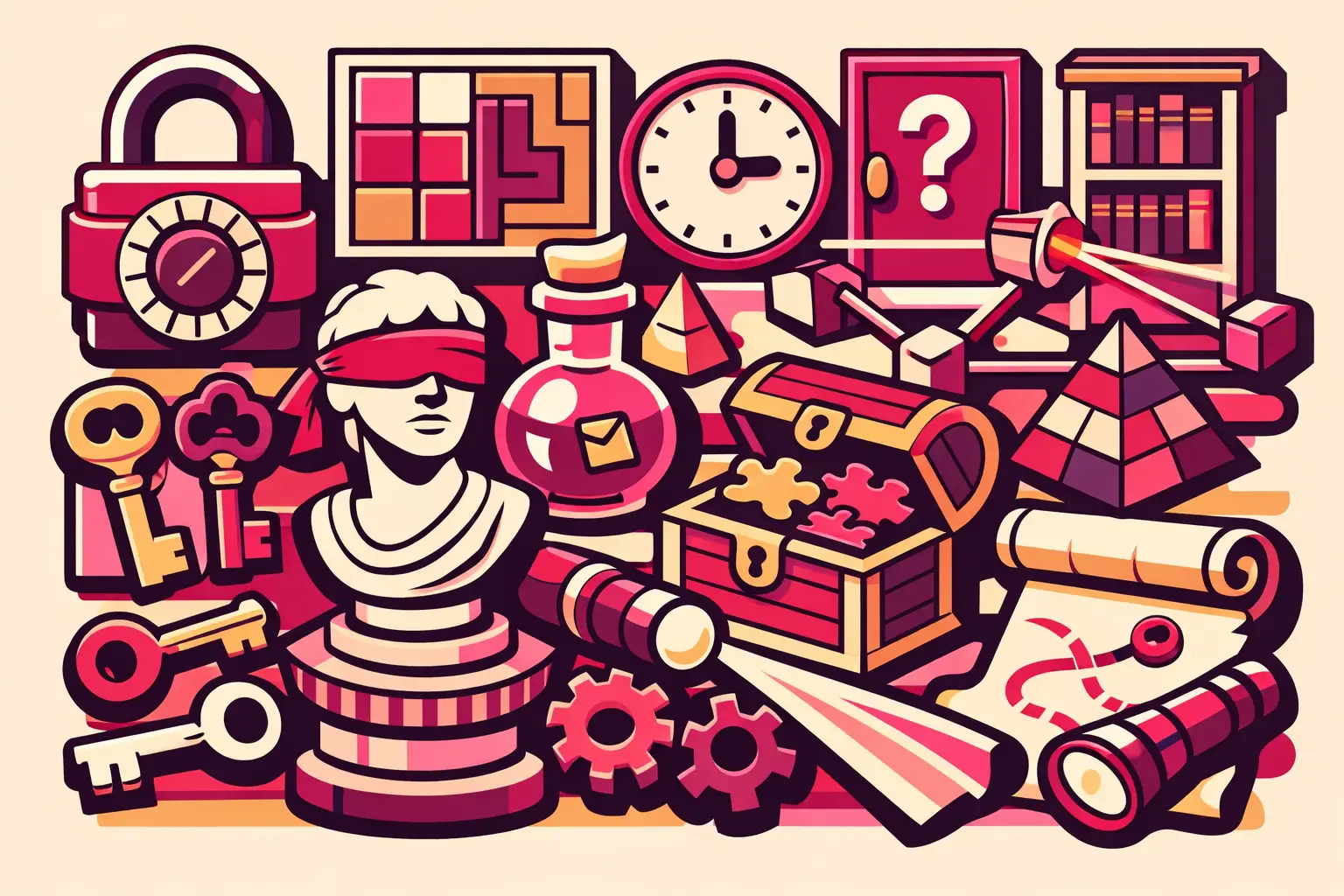
A locked box, a strange symbol on the wall, a message buried in a newspaper - escape room puzzle types turn ordinary details into the next step of a live mission. Knowing what you might encounter can help your group stay organized, communicate faster, and spend more time enjoying the story instead of wondering where to start.
The goal is not to memorize tricks or beat a room before you arrive. Great escape rooms are built to surprise you. But once you recognize the broad categories, your team can divide up naturally: one person searches, another spots patterns, and someone else keeps track of the clues already used.
12 Escape Room Puzzle Types to Expect
1. Hidden-object searches
Some clues are in plain sight. Others are tucked inside props, behind picture frames, under furniture, or in places that fit the room's story. A hidden-object puzzle asks players to search carefully without treating the room like a demolition project.
The best approach is systematic. Scan one area at a time, announce what you find, and place loose clues in a shared spot. If someone finds a key, note where it was used. That one habit prevents the classic escape room problem: three people searching for an item that is already in someone's pocket.
2. Combination locks
Number locks, letter locks, directional locks, and symbol locks are escape room staples for a reason. They give a satisfying click when your team has connected the right information. The challenge usually is not guessing the code. It is figuring out which clue belongs to which lock and in what order to read it.
Before entering a combination, check the lock format. A four-letter lock needs letters, not a four-digit date. If the room offers several possible numbers, look for a clue that establishes the sequence, such as color order, position, or a clearly marked starting point.
3. Pattern recognition puzzles
Patterns may appear in colors, shapes, objects, sounds, map locations, or repeated words. These puzzles reward players who can step back and ask, "What is this information trying to tell us?"
Do not force every repeated detail into a complicated equation. Sometimes the pattern is as simple as arranging objects from smallest to largest or matching each symbol to its location. If your first theory requires too many assumptions, try a cleaner one.
4. Observation and visual-detail challenges
A painting may contain a detail that matches a coded note. A bookshelf may have a sequence hidden in book titles. A room's décor can be more than atmosphere. Observation puzzles test whether your team notices what is unusual, missing, duplicated, or intentionally arranged.
These challenges are especially good for groups with different strengths. The person who does not love math may be the first to spot that one clock is set differently or that a set of objects forms a visual clue. Say discoveries out loud, even if they seem small.
5. Word and language puzzles
Word puzzles can involve anagrams, riddles, acrostics, ciphers, substitutions, or clues hidden in a letter, journal, menu, or old document. You do not need to be a crossword champion, but it helps to read every word carefully.
Look for instructions before trying to decode a message. A strange collection of letters might point to the first letter of each line, a shift in the alphabet, or a keyword found elsewhere in the room. If a word puzzle feels impossible, another undiscovered clue may provide the method.
6. Math and logic puzzles
Some escape room puzzle types use numbers, logic grids, weights, measurements, or simple calculations. The math is usually accessible. The real challenge is identifying which numbers matter and how they relate.
Avoid doing complicated calculations just because numbers are present. A date may be a lock code, a count of objects, or part of a larger pattern. Write down your work so teammates can check it and so you do not repeat the same dead end ten minutes later.
7. Physical assembly puzzles
These puzzles ask your group to build, arrange, stack, connect, or position physical pieces correctly. You might assemble a map, fit objects into a display, place tokens in a sequence, or manipulate a mechanical device.
Pay attention to how pieces are shaped and whether they have markings, colors, or textures. If an object does not fit, do not force it. Escape room props should be handled with care, and forcing a mechanism can break the experience for your group and the teams after you.
8. Light, sound, and sensory puzzles
A flashlight may reveal hidden ink. A recording may contain a key phrase. Lights, music, sound effects, and other sensory elements can carry information that is easy to miss when the room is buzzing with conversation.
When something changes, pause for a moment. If a door opens, a sound plays, or a light switches on, make sure everyone notices. One person listening while the rest of the group talks can miss a clue that was meant to move the mission forward.
9. Technology-based puzzles
Screens, buttons, magnetic sensors, electronic panels, and interactive props can create memorable moments because the room responds to what your team does. These puzzles often combine a physical clue with a digital result.
Treat technology with patience. Follow visible instructions, use only the controls intended for play, and ask for a hint if a device seems unresponsive after you have confirmed your solution. Not every electronic prop gives immediate feedback, and sometimes the next action is elsewhere in the room.
10. Map and navigation puzzles
Maps turn up in adventure, mystery, historical, and spy-themed rooms. Your group may need to trace routes, identify coordinates, line up landmarks, or connect locations to symbols and numbers.
Orientation matters. Check for a compass rose, labels, a legend, or an obvious starting point. A map puzzle becomes much easier when one teammate holds the map while another reads the related clue aloud. It is a simple form of collaboration that reduces mix-ups.
11. Sequential and multi-step puzzles
Not every puzzle produces a final answer right away. A clue may open a compartment containing a tool, which reveals a message, which provides the code for the next lock. These chains create momentum and make the room feel like a connected story rather than a collection of random tasks.
Track your progress. Put solved clues aside when possible and keep newly revealed items visible. If your team gets stuck, ask what changed most recently. The next usable clue is often connected to the last thing you opened or activated.
12. Teamwork and communication challenges
Some puzzles are designed so one person cannot solve them alone. Players may need to share information from opposite sides of the room, coordinate timing, compare separate clues, or complete simultaneous actions.
These are often the most memorable moments in an escape room because everyone has a job. Keep instructions short and specific: "I have three symbols," "Try the red button," or "Read the second line again." Clear communication beats shouting every time.
How to Handle Different Escape Room Puzzle Types
The strongest teams do not have one genius player doing everything. They share what they see, test one sensible idea at a time, and switch tasks when a puzzle stops moving. A fresh set of eyes can spot an answer that the original solver has stared past for five minutes.
Use hints strategically, too. Asking for help is not failing the mission. A good hint can confirm that you are working on the wrong puzzle, point you toward an overlooked area, or keep the group's energy up when the clock is running down. The right moment depends on your goal: experienced players may want a tougher challenge, while a birthday group may care more about keeping the action moving.
Most importantly, respect the room's rules. Do not use excessive force, climb on props, or attempt to open anything marked out of play. Escape rooms are designed around safe, intentional interactions. The puzzle is in the clues, not in breaking the set.
Whether your group loves codes, hands-on challenges, or story-driven mysteries, variety is what makes the experience work. Gather a team, trust each other's strengths, and let the next clue pull everyone deeper into the mission. For a Philadelphia outing that gives everyone something to do, that shared moment of solving it together is hard to beat.
Use Non-Spoiler Puzzle Categories
A puzzle-types guide can prepare new players without revealing a live solution. Useful categories include observation, sequence, spatial arrangement, wordplay, pattern matching, object association, communication, and combining information found by different teammates.
MindEscape's published room themes support only broad examples: a Victorian mystery rewards close observation, a prison-break story frames collaborative searching, and a botanical mystery uses nature-and-science inspiration. Specific mechanisms and answers should remain inside the rooms.
Use these MindEscape planning paths
- current room comparison — choose a theme without puzzle spoilers
- preparation guide — practice team habits rather than answers
- difficulty guide — separate puzzle type from challenge level
- tabletop and puzzle-fan guide — connect shared solving habits across formats