
Can Couples Solve Escape Rooms? Yes, With a Plan
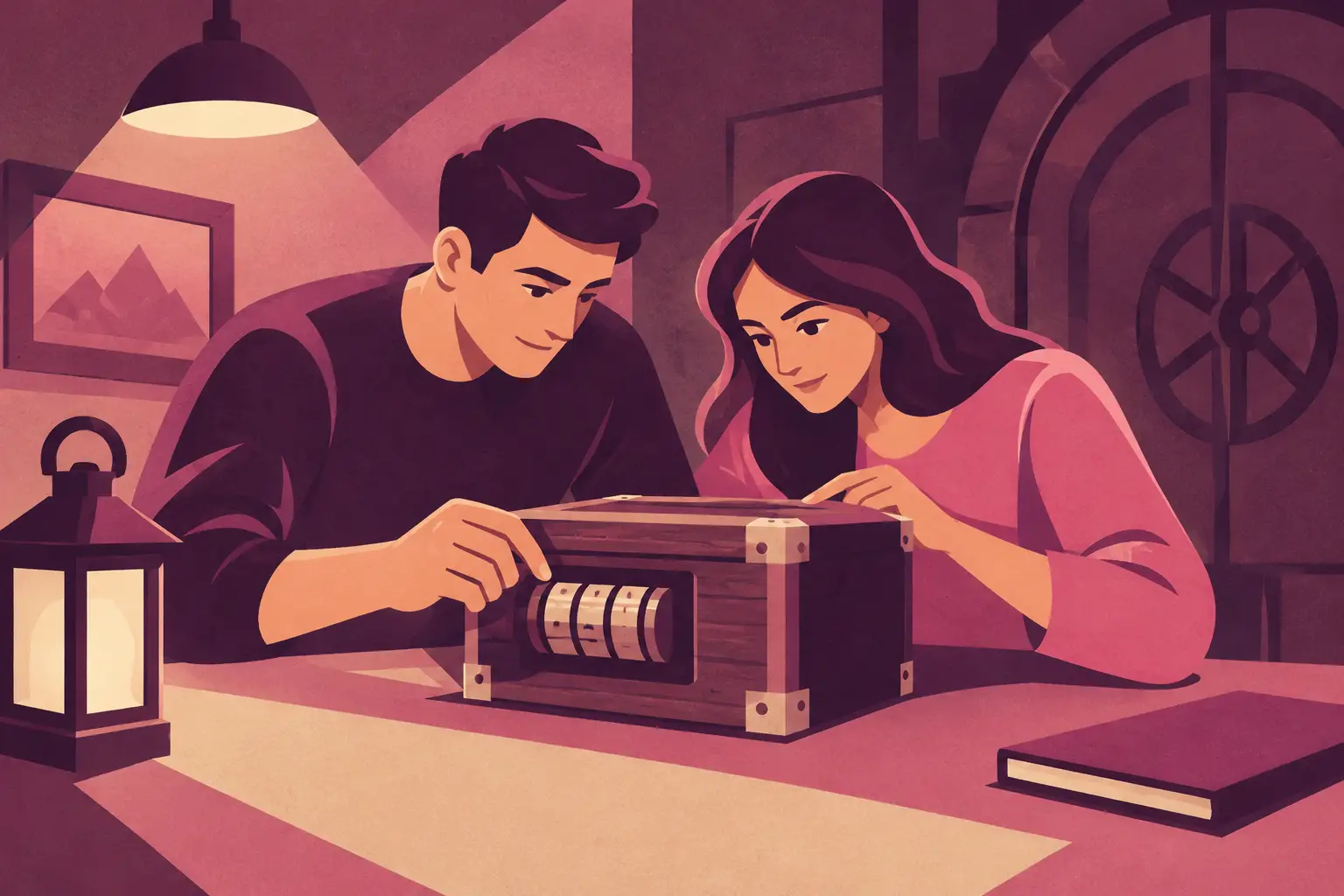
A locked cabinet, a strange clue, and 60 minutes on the clock can reveal a lot about how two people think together. So, can couples solve escape rooms? Absolutely. A pair can be an excellent escape-room team, especially when both players are willing to share ideas, stay curious, and move on from a theory that is not working.
The real question is not whether two people are capable. It is whether the particular room, its player range, and your shared style of problem-solving make a two-player attempt feel exciting rather than cramped. Some couples enjoy the intensity of having every discovery matter. Others would rather bring friends so the room has more sets of eyes and fewer moments where both people are staring at the same stubborn clue.
Why two-player teams can be surprisingly strong
A couple enters with one advantage that new groups often need time to build: familiarity. You may already know whether your partner tends to notice visual details, read instructions closely, remember a fact from earlier, or jump quickly into hands-on tasks. That familiarity can make communication fast and natural.
Two people also make decisions with less friction. In a larger group, several theories can compete for attention at once. With a pair, you can test an idea, see what happens, and adjust without needing to gather the room around a long discussion. When a clue clicks, you both know why it clicked. That creates a satisfying sense of momentum.
There is also nowhere to disappear. In a big team, it is possible to let the most vocal players take over while everyone else watches. A two-person game asks both guests to stay involved. For couples who enjoy being active participants rather than spectators, that is part of the appeal.
Still, familiarity is helpful only when it leaves room for surprise. Escape rooms reward a guest who says, “Try it,” and another who says, “Wait, what if we read that differently?” Couples do best when neither person treats their first idea as the final answer.
What makes a couples escape room harder
Two players have less bandwidth. That is the honest trade-off. A larger group can have one person searching, another connecting clues, and someone else testing an idea at the same time. A couple may need to choose where to direct attention, then switch gears when a discovery opens a new thread.
That does not mean a pair is at a disadvantage in every room. It means your pace will depend more heavily on how efficiently you observe, communicate, and reset. If one of you gets focused on a single possibility, the other person needs permission to question it without turning the moment into a debate.
The pressure can feel sharper, too. When the clock is visible and there are only two of you, a quiet stretch may seem like a major setback. Usually, it is not. Escape-room progress is rarely a straight line. A clue you cannot place at minute 15 may make perfect sense after another part of the room changes your perspective.
The best response is not to push harder at the same dead end. Name what you have noticed, set it aside for a moment, and examine the information you have not yet used. That is not a special escape-room trick. It is simply good collaboration under a little theatrical pressure.
Can couples solve escape rooms if they think differently?
Often, that difference is exactly what helps. One person may be drawn to a pattern while the other notices the wording on a document or a detail in the environment. The point is not to have matching brains. The point is to make both approaches visible.
Trouble begins when one player filters every idea through their own preferred method. If you are a methodical person, a fast intuitive guess from your partner can feel random. If you like to experiment, a careful check of the available information can feel slow. In a good two-player run, each style gets its moment.
A useful test is how you handle being wrong together. Escape rooms include false assumptions, missed details, and clues that only become meaningful later. Couples who can laugh, revise, and keep moving usually have more fun than couples who need to establish who was right. You are not being graded on perfect reasoning. You are building a shared story one discovery at a time.
That is why a room can be a better fit for a couple than a competitive activity. There is one central problem in front of you, not a scorecard placing one person above the other. Even when you disagree, you are still on the same side of the locked door.
Choosing the right level of challenge for two
Before booking, look carefully at the stated player range. A game designed to accommodate two players is a more sensible choice for a pair than one that simply allows a large maximum group. Player range is not a promise that every team size will experience the room in the same way. It tells you the scale the experience can support.
Then consider what you actually want from the hour. If you want a focused challenge with constant involvement, two players can be ideal. If you want a relaxed social outing where there is room to chat, compare theories, and absorb the setting without feeling rushed, adding another couple or a few friends may be the better call.
Theme matters as well. Mystery, adventure, and horror can all create very different energy in a small team. A suspenseful setting may feel more immersive with only two people because every sound and detail has your full attention. For some guests, that is the fun. For others, a larger group makes a darker theme feel more comfortable. Be honest about what kind of atmosphere you both enjoy before choosing.
At MindEscape in Philadelphia, the current 60-minute experiences accept teams starting at two players. That makes the venue a practical option when you want to take on a shared challenge without recruiting a full group. Check the live room descriptions before you book so you can match the theme and stated group size to the experience you want.
When it makes sense to bring more people
A two-person booking is not automatically the best choice just because you are going together. Bring additional players if one or both of you prefer lots of conversation, want more perspectives on a difficult challenge, or would rather enjoy the theatrical setting with less responsibility resting on each person.
More guests can also change the mood. A pair tends to create an intense, close-focus experience. Four people can create more banter, more simultaneous discoveries, and more chances for someone to spot what everyone else missed. Neither format is better. They serve different versions of a good time.
If you do invite others, choose people who enjoy collaboration rather than people who want to race ahead alone. A group that shares discoveries can make a room feel bigger and more alive. A group that splits into private missions can leave a couple feeling like they came along to watch.
Make the hour about the shared experience
The finish matters, but it is not the whole story. Some couples leave talking about the exact moment a strange detail finally made sense. Others remember the wild theory that turned out to be completely wrong. Those moments are the value of taking on an escape room as a pair: you get a concentrated hour of noticing, debating, reconsidering, and celebrating together.
Choose a room that fits your comfort level, let both people contribute in their own way, and treat every wrong turn as part of the plot. Whether you escape or not, you will have a much better story than you started with.